
Repository evidence, agent instructions and document workflows.
Markdown now serves several jobs in the same project: explaining software to people, holding instructions for coding agents, and supplying source text for published documents. The evidence is strongest for its presence in established public repositories. It is much weaker on how often people move that text between tools, whether instruction files improve an agent's work, or how much demand exists for document export.
The Markdown Layer examines those boundaries. This edition combines published research, current format and product documentation, and a small original repository study. It offers a practical model for keeping source text understandable as it moves between people, software and AI systems.
Published and last reviewed: September 30, 2026. Edition: 1.0. Publisher: MD2FILE Team. The closing 2027 outlook is a set of questions to test, not a report of future results.
Download the full report (PDF) · Markdown report · Methodology · Repository data (CSV)
What the evidence supports
Five findings shape this report:
- Markdown is well established in the public software projects studied. A 2026 academic sample found
README.mdsomewhere in 9,532 of 10,000 selected repositories. That population had activity, star and commit requirements; it does not represent every GitHub repository. - Agent instruction files have become a measurable repository artifact. A separate September census found at least one recognized instruction filename in 2,463 of 7,370 large, recently active repositories. Presence alone says nothing about whether an agent used the file successfully.
- Our original panel exposes coexistence and uneven volume. We inspected 21 complete trees from 24 selected repositories. All 21 contained Markdown; 15 contained at least one of four context filename candidates. Two repositories accounted for 27,715 of the panel's 35,904 Markdown files.
- Agent effectiveness remains conditional. Experiments use different tasks, agents, instruction sources and outcomes. A reduction in runtime or output tokens does not establish better correctness, lower total token use, or a benefit for another repository.
- Portable text still needs a rendering and provenance check. A file can survive transfer while its diagrams, relative images, citations or page layout fail. Keeping the source and documenting the export decision helps the next reader understand what they received.
The first two figures come from Hora and colleagues' repository study and Stride's September census. Their populations and methods differ. Our original panel and limitations are published separately so the three datasets remain distinguishable.
One format, several responsibilities
Markdown's original design favored source that a person could read before conversion to HTML. That remains useful when the same text appears in a repository, editor, note system or prompt. Its readable syntax lowers one transfer cost: a recipient can often inspect the content without the application that created it. It does not carry every application's behavior with it. See the original Markdown description and the CommonMark specification.

Consider a team preparing a release. Its README explains installation, a scoped instruction file tells an agent which test suite to run, and a release note records the changes. A PDF version might go to a customer who does not use the repository. These artifacts can share a syntax while requiring different checks. The installation command must work, the instruction must apply to the current directory, and the customer document must remain readable without repository-relative assets.
We use Markdown layer as an editorial description of that shared text surface. It is not a new standard or a claim that every AI system uses Markdown internally. The useful question is what must accompany the text at each handoff: context, permissions, assets, review history or renderer settings.
| Handoff | What the text carries | What still needs checking |
|---|---|---|
| Maintainer to contributor | Explanation, commands, links | Commands and links match the current project |
| Maintainer to coding agent | Task context and repository conventions | Scope, precedence, actual tool permissions |
| Writer to another editor | Headings, paragraphs, source references | Dialect, attachments, application-specific features |
| Editor to reader | A rendered document | Fonts, diagrams, pagination and provenance |
Repository adoption: keep the denominator attached
Large numbers are useful only when their populations remain visible. The studies below answer different questions. None provides a count of all Markdown users, and combining them into a single adoption rate would discard the very distinctions that make them interpretable.
| Evidence | Population and observation | What it supports |
|---|---|---|
| Academic repository study, July revision | 10,000 sampled projects from an eligible frame of 116,013; at least 100 stars, 100 commits and a 2026 commit | Common document filenames in established, active repositories |
| Stride census, September 27 | 7,370 public, nonfork, nonarchived repositories with at least 5,000 stars and recent activity | Instruction filename presence under that census's rules |
| MD2FILE panel, September 30 | Six highest-starred qualifying results for each of four languages; 21 complete trees, three unknown | An inspectable snapshot of file roles and concentration |
The academic paper reports .md in 9,860 sampled repositories. Its document-name counts search across the tree; they are not all root README counts. Its historical comparison uses a different surviving-project denominator, so we have not drawn a ten-year growth curve from those endpoints. The adoption chapter explains that distinction.
Our panel selected Python, TypeScript, Rust and Go repositories through GitHub search, then pinned each selected result to an immutable commit. This intentionally small, popularity-based panel includes educational collections and large documentation trees. It is useful for inspecting files, but unsuitable for estimating prevalence across a language community.
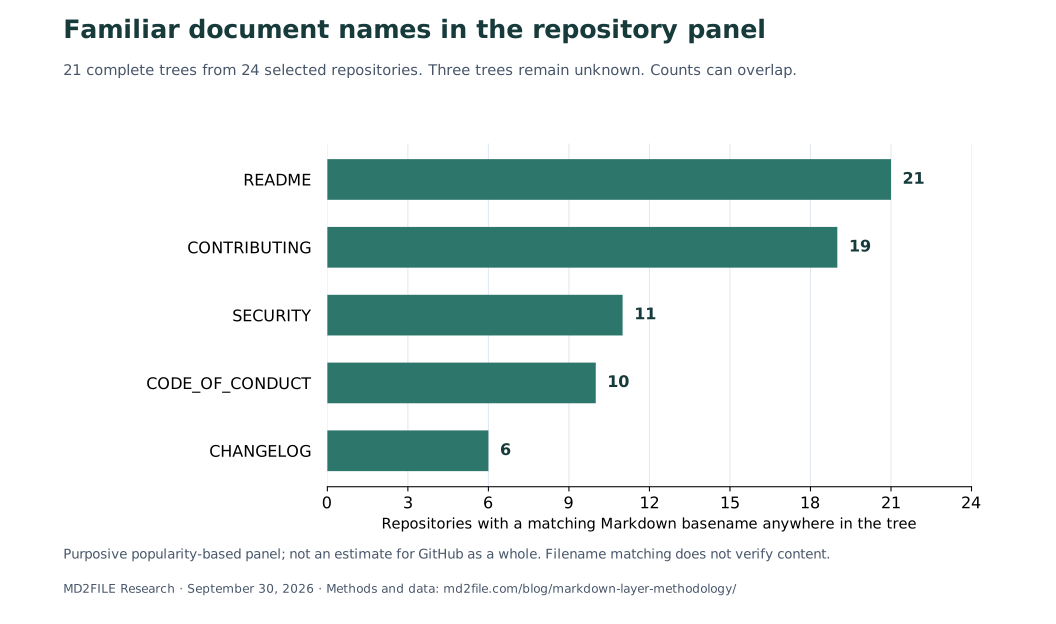
| Markdown basename, anywhere in a complete tree | Repositories containing it |
|---|---|
| README | 21 |
| CONTRIBUTING | 19 |
| SECURITY | 11 |
| CODE_OF_CONDUCT | 10 |
| CHANGELOG | 6 |
Counts overlap. The three incomplete responses exceeded our client's 12 MiB response ceiling: openclaw/openclaw, rust-lang/rust and microsoft/TypeScript. Their unobserved counts remain unknown. A missing result from a partial tree must never become evidence that a file is absent.
File volume is especially easy to misread
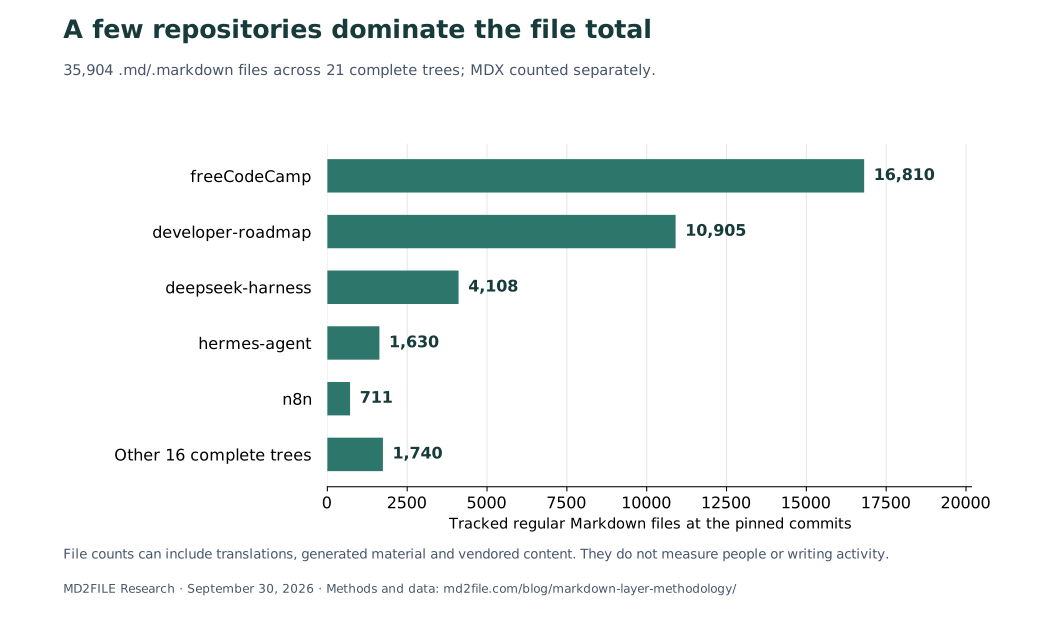
| Repository or group | Regular .md / .markdown files |
|---|---|
| freeCodeCamp/freeCodeCamp | 16,810 |
| nilbuild/developer-roadmap | 10,905 |
| deepseek-ai/deepseek-harness | 4,108 |
| NousResearch/hermes-agent | 1,630 |
| n8n-io/n8n | 711 |
| Other 16 complete trees | 1,740 |
| Total across 21 complete trees | 35,904 |
A translation, fixture, generated page or vendored document can contribute to that total. We did not read every file, classify authorship, or measure monthly writing activity. The distribution is evidence of concentration within this panel. It cannot tell us how many people adopted Markdown or how much AI increased document creation.
Agent instructions: presence, loading and usefulness
An instruction file gives an agent project context that might otherwise need repeating in each request. It can name the test command, identify generated directories or explain a convention. That value depends on the agent discovering the right file and on the instructions remaining relevant.
Our filename scan found the following mutually exclusive combinations. Candidates can appear in examples, templates, fixtures or vendored material; the scan does not establish that they control the repository's own agent workflow.
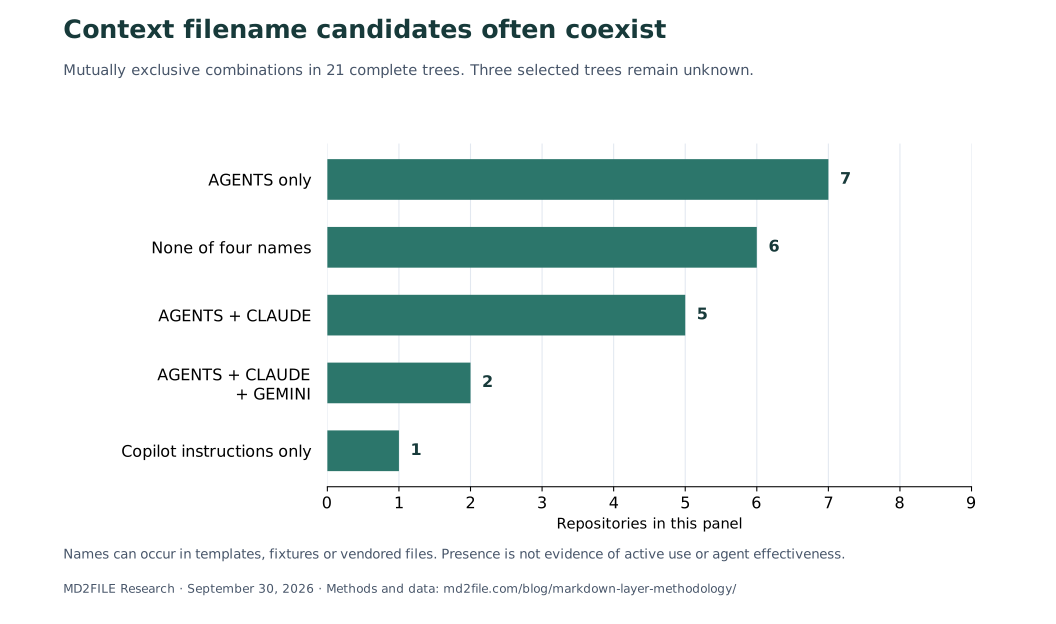
| Combination of filename candidates | Repositories |
|---|---|
| AGENTS only | 7 |
| None of the four names | 6 |
| AGENTS and CLAUDE | 5 |
| AGENTS, CLAUDE and GEMINI | 2 |
| Copilot instructions only | 1 |
Coexistence creates a practical question: which file is authoritative for this task? A shared instruction can be referenced from tool-specific files, but precedence and discovery remain tool behavior. The AGENTS.md project explains the format; each agent's current documentation still needs checking before relying on a loading rule.

Two experiments illustrate why effectiveness needs a narrower claim. Lulla and colleagues tested 124 small pull-request tasks in ten repositories with curated instruction files present or removed. Median runtime fell from 98.57 to 70.34 seconds; median output tokens fell from 2,925 to 2,440. Those are not total-token or comprehensive correctness results.
The September 29 revision of Gloaguen and colleagues' evaluation tested generated and developer-committed context across two benchmarks and four model/harness setups. Success differences against no context were not statistically significant; generated context increased average cost by 20% and 23% in SWE-bench Lite and CTXbench, respectively. That result does not establish equivalence, or justify applying those percentages to another workflow.
The sensible local experiment is small: define representative tasks, hold the agent setup steady, compare a specific instruction change, and inspect both correctness and effort. The agent instructions chapter separates adoption studies from those experiments and gives a worked evaluation example.
Documentation needs an owner and an expiry condition
Generating another guide is cheap enough that a repository can accumulate several accounts of the same procedure. The maintenance problem begins when those accounts disagree. A confident instruction pointing to an obsolete command can cost more review time than the original command would have saved.
Markdown Mayhem is a position paper about this risk. It supplies a useful problem framing, not a measured industry-wide rate of documentation growth or contradiction. Our panel likewise measures files at one moment; it cannot establish an explosion over time.

A workable practice is to connect each durable instruction to the thing that can invalidate it. A build command depends on the package script. A release procedure depends on the deployment path. A security boundary depends on actual permissions. Review can then follow a concrete change rather than a vague request to keep all documentation fresh.
For a small team, that might mean one canonical setup guide, scoped additions where behavior differs, and a checklist in the pull request that changes the underlying command. Larger teams may need explicit owners and periodic samples. Neither approach requires a second copy of every instruction. The maintenance chapter includes a conflict-resolution example and a compact review record.
Knowledge portability has several layers
Plain text is easy to copy. Meaning can be harder to move. A relative image path depends on a directory; an embedded diagram depends on a renderer; a note's backlink view depends on its application. The transfer can succeed at the file level while losing information the reader relied on.

GitHub Flavored Markdown defines extensions such as tables and task lists. Mermaid rendering and math support still require implementation choices beyond assuming every Markdown viewer behaves alike. An export checklist should therefore name the actual features a document uses, rather than label the whole file simply compatible.
| Layer | A useful transfer check |
|---|---|
| Text | Can another editor open and preserve the source? |
| Syntax | Do tables, code fences and task lists mean the same thing? |
| Assets | Are images and referenced files included or still reachable? |
| Application behavior | What happens to backlinks, embeds or plugins? |
| Publication | Can the recipient read the result on their device? |
For a research note, retain stable source links and enough citation detail to identify the work after a URL changes. For a team handbook, send the associated assets and identify the version. For a client deliverable, keep the editable source even when the chosen reading format is PDF. The knowledge portability chapter turns those checks into a small transfer exercise.
The last mile is a document decision
A source document and its rendered output serve different needs. Source supports editing and review; a PDF fixes a particular presentation for circulation. Export is the point at which the team must decide which content, assets and version a reader should see.

Review a representative difficult page: a wide table, long code line, diagram, equation, non-Latin text or a section break. Check selectable text, working links and whether a figure has an explanation that survives without color. A visually polished PDF is not automatically an accessible PDF. Browser screen layout also differs from paged media.
This is where our products enter the workflow. The MD2FILE web editor is an option when Markdown needs editing and preview before PDF or HTML export. The Markdown-to-PDF extension serves the narrower case where a .md file already exists. The PDF review chapter explains how to inspect the output from these and other conversion paths; our Mermaid and math guide covers specific rendering checks.
Local rendering describes a processing step. It should not be taken as a promise that an application makes no network requests: linked assets, optional AI services, cloud features and account functions can have separate data flows. Choose the workflow based on the document's requirements and the tool's current permissions and privacy information.
AI conversations need editorial selection
A conversation can contain a useful explanation alongside abandoned assumptions, private context and unverified references. Exporting every message preserves the exchange, but does not necessarily produce the clearest document for a colleague. The first decision is whether the deliverable is a transcript, an edited brief or a decision record.

For a decision record, keep the question, constraints, chosen action, unresolved questions and source references. Identify substantive human edits and the date of review. A transcript may instead need participant turns and omitted-range notes. Neither format turns an AI-generated claim into verified evidence merely by giving it a durable filename.
The AI Chat Exporter provides a PDF workflow for selected responses or conversations. It is a different entry point from an existing Markdown file. It does not remove the need to select material, review citations or consider whether prompts contain information that should be shared. The AI conversations chapter gives examples of those editorial choices.
What to watch in 2027
The evidence does not justify declaring a winner among instruction formats or predicting export demand. A useful next edition would test narrower questions against this baseline.
| Question | Evidence needed | What would change our interpretation? |
|---|---|---|
| Do instruction files remain actively maintained? | Repeated observations at pinned commits, with change review | Files persist but their guidance becomes stale |
| Does shared guidance reduce duplication? | Content-level analysis with explicit permission and scope rules | Multiple filenames contain conflicting instructions |
| Does portable source survive real transfers? | Repeatable fixtures across named tool versions | Text survives while required assets or semantics fail |
| Which conversations become documents? | Consented workflow research with a defined population | Export use is narrow or mainly archival |
| Does an instruction change help a team? | Local task outcomes, effort and review quality | Added context increases work without useful gains |
These are research proposals. No 2027 observations are included in this edition, and the current panel should not be silently expanded and compared as though it were a fixed cohort. A future update should state which repositories were retained, replaced or still unobservable and why.
Methods, downloads and citation
Our September 30 collection used four public GitHub search queries, selected six results per language, and pinned each repository's commit and tree. We counted regular .md and .markdown files, recorded MDX separately, and classified named document/context candidates using disclosed rules. The collection made 53 read-only requests. Three trees remained incomplete under the response-size limit.
The public files contain processed repository metadata and classified paths, not copied repository contents. The methodology explains the sampling bias, completeness flags, exclusions and reproduction options. The published script can check aggregate consistency offline; refetching the 21 complete trees at their pinned identifiers is a separate bounded operation. An offline consistency check alone does not re-observe GitHub.
- Repository panel JSON and CSV
- Classified file paths and reproduction script
- Mermaid lifecycle source
- Source register, plain-text citation and BibTeX
- Full PDF report and editable Markdown report
Suggested citation: MD2FILE Team. (2026). The Markdown Layer: State of Markdown 2026. Version 1.0, September 30. https://md2file.com/blog/the-markdown-layer/.
Editorial disclosure: MD2FILE publishes this report and sells tools discussed in it. AI assisted research, drafting, code and the cover illustration; the source checks, retained data and limitations are documented so readers can inspect the claims. Charts are calculated from the published panel. Workflow diagrams are conceptual, created with Mermaid, and do not represent measured traffic or user journeys. Product documentation and source inspection are not a security audit or a test of every current browser/provider combination. This edition includes no user survey, private usage analysis or causal SEO result.
Read the research series
| Chapter | The question it answers |
|---|---|
| Markdown adoption in repositories | What can repository counts actually tell us? |
| Markdown for AI agents | When do instruction files help, and how would we know? |
| Maintaining agent documentation | How should a team manage scope, ownership and stale guidance? |
| Markdown knowledge portability | What survives when a document moves between tools? |
| Checking a Markdown PDF | What needs checking in a PDF before it is shared? |
| AI conversations as documents | How does a conversation become a useful record? |
| Methodology and limitations | How were the sources, panel and counts checked? |